TikTok Slideshow Format for Brand Content
Photo Mode and auto-play slideshows are entirely different formats competing on different metrics.

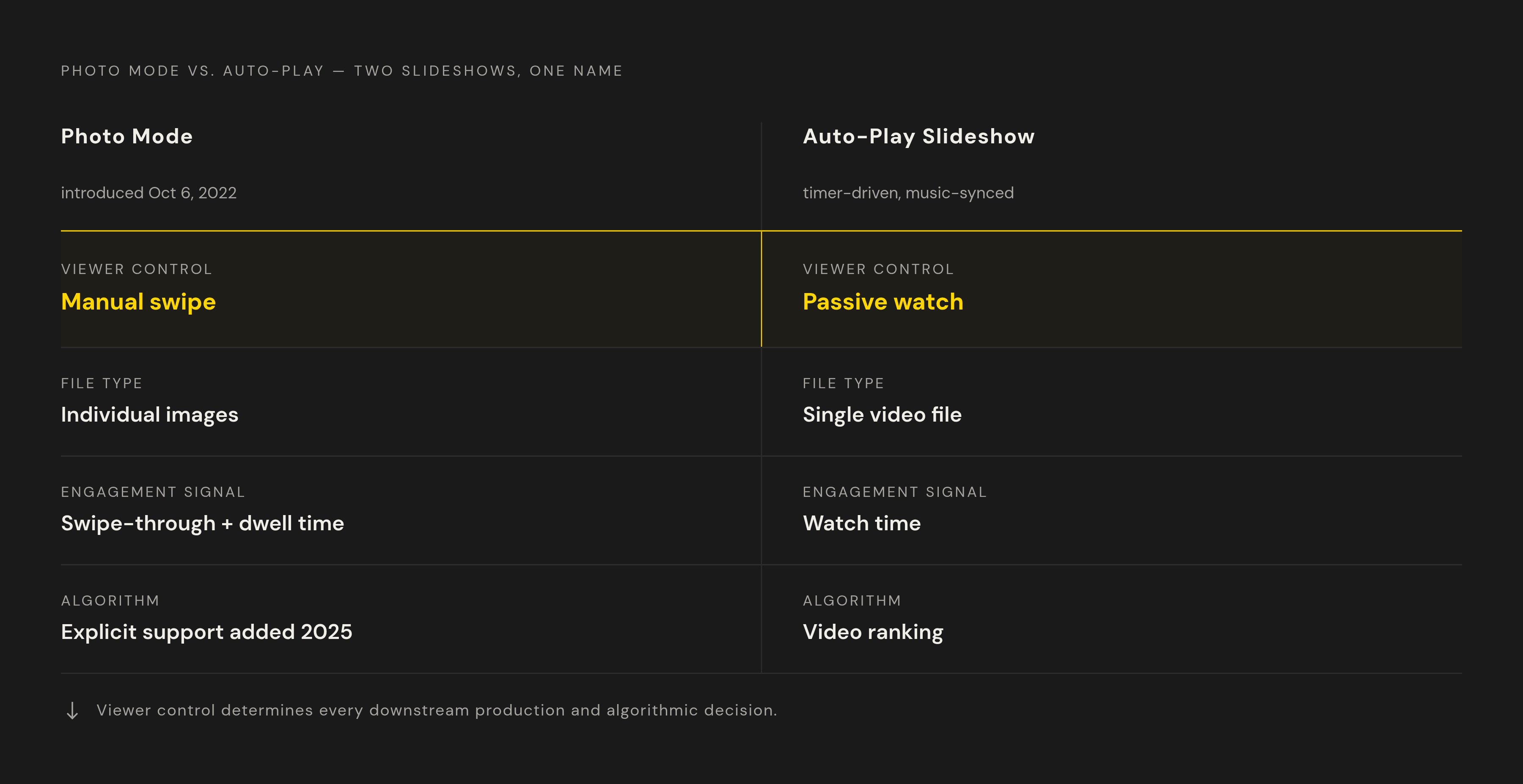
Brands routinely build the wrong format because two entirely different TikTok post types share the same casual name. A team sets out to make a "slideshow," builds it the way they've always built one, and ends up with content optimized for the wrong engagement signals before a single image gets uploaded. Photo Mode is the native, built-in post type, accessed through its own creation flow rather than the video camera, where viewers manually swipe through still images at whatever pace they choose. It behaves much closer to an Instagram carousel than to anything resembling a video clip. Swipe manually and the engagement signals recorded are swipe-through rate and dwell time per slide; leave it alone and the post auto-advances after a few seconds, but the underlying file still saves as a set of individual images rather than a single video. The other format, the auto-play slideshow, transitions images automatically on a timer, syncs them to music, and exports the whole thing as one video file, which makes the viewer's role passive and the primary engagement signal watch time rather than swipes. TikTok introduced Photo Mode in October 2022, announced on October 6, 2022, as a new carousel format for sharing still images, and the company has refined it steadily since then, including explicit algorithmic support added in 2025 that remains active in 2026. That distinction, manual control versus automatic playback, is what the rest of this piece builds on, because every production decision and every algorithmic signal downstream depends on which format a brand actually built.
The technical specs that determine whether a Photo Mode post renders correctly
Getting the specs wrong produces a post that looks unfinished, regardless of the strength of the content underneath it. The recommended dimension is 1080×1920 pixels at a 9:16 vertical aspect ratio, which fills the entire screen; square and 4:5 portrait images are supported, but both produce letterboxing. Slide count tops out at 35 images per carousel, and a spec page verified in September 2026 dropped a previously stated four-image minimum, leaving the stated ceiling of 35 as the only hard number, with carousel ads requiring a minimum of two images. The entire carousel is capped at 500MB, and each individual image should stay under 100KB so that every slide loads quickly as a viewer swipes through, rather than stalling on a slow connection. Keep essential content inside a safe zone of roughly 900×1600 pixels at the center of the frame; anything placed outside that zone risks being covered by TikTok's own interface, including the profile picture and the like, comment, and share buttons stacked along the right edge, plus the caption running along the bottom. Text needs to clear a legibility floor on a mobile screen: headlines at a minimum of 48px, body copy at a minimum of 32px. This has to be designed outside the app itself. Photo Mode's in-app text tools are built for quick captions, not layout-heavy design work, so slides need to be built in a dedicated design tool first and then uploaded as finished images.
How TikTok's algorithm reads carousel posts differently from video
Photo Mode produces its own distinct set of engagement signals, and TikTok's algorithm weights those signals differently than it weights the signals a video generates, per the late-2025 algorithm update that remains active in 2026 and establishes the primary ranking signals for carousels. A carousel built with a video mindset will underperform even with strong visuals. A still image gets assessed by a viewer almost instantly, within a fraction of a second, while a video clip needs one to three seconds before a viewer understands what they're looking at, and that gap gives Photo Mode a higher initial stop rate. TikTok also indexes the text printed on a photo slide, and the text on the first slide functions as the strongest search signal a carousel carries, which gives Photo Mode posts a longer shelf life than video, since video depends heavily on the For You Page and an algorithmic window. Photo Mode also interrupts an otherwise video-dominant feed, which itself signals novelty and contributes to session time, one reason TikTok has actively promoted the format, and conflating Photo Mode with TikTok's other photo-based format, which works entirely differently despite sharing a casual name, is the most common reason brands deploy the wrong one. Carousels generate saves at a meaningfully higher rate than other formats, and a save signals something a like never does: a viewer who intends to come back to this content later, at the moment they're ready to act on it. That's the signal the rest of this piece is built around, because a save is closer to purchase intent than any passive view could ever be.
Why carousels win on saves, not views
The honest starting point for this argument is uncomfortable: video substantially outperforms carousels on raw interaction counts, and that gap isn't marginal. Treating Photo Mode as a like-for-like substitute for video, judged by the same reach metrics, sets a brand up to call the format a failure. Part of the problem is structural. The feed is increasingly saturated with carousels that underperform on raw reach, and posting more of them without a disciplined content structure behind each one doesn't fix that, it just adds to the saturation.
The resolution isn't that carousels are secretly better at the thing video does well. Carousels are built for a different contest entirely: they compete inside TikTok search, where the operative metrics are saves and return visits rather than view counts. The defensible argument for Photo Mode gives it a narrow job, functioning as a search tool, a save engine, or a visual spec sheet, rather than asking it to produce the reach numbers video produces. Brands reaching for carousels purely as a low-effort way to post more content, without building toward that save-and-return behavior, end up flooding the feed with more underperforming carousels, and they get the weaker half of both formats for their trouble.
The three content situations where Photo Mode outperforms video for brand goals
Photo Mode earns its place in a brand's content mix inside a specific, bounded set of situations, and using it only there is what preserves its save and search advantages; spreading it across everything else dilutes both.
The first situation is visual-contrast products: anything whose sale depends on a before-and-after, a size comparison, or a visible transformation. A swipe from one state to the next delivers that contrast more clearly than a video cut does, because the viewer sets the pace and can linger on the "after" slide as long as they need to, and that lingering behavior is what produces a save.
The second is multi-angle and detail products, the category of purchase where the buyer's real question is some version of "what does this actually look like." A carousel lets that buyer advance through angles on their own schedule, with dimension labels or material callouts attached to each slide. Home decor and accessories sit naturally here, along with any product where the decision is fundamentally visual and comparative rather than emotional.
The third is information-dense products, where the sale depends on something scannable: an ingredient list, a spec sheet, sizing information, or a rundown of what's included in a kit or bundle. A carousel turns what would be rapid-fire spoken claims in a video into slides a viewer can save and return to mid-comparison, and that return visit is the conversion signal the format is built to capture.
A fourth pattern sits alongside those three: educational, swipe-through content structured as a progressive reveal, where each slide adds genuinely new information rather than repeating the last one, and the final slide delivers the payoff. That structure drives completion rate and saves at the same time, which is precisely the combination the algorithm rewards most.
The governing rule is simple: if a product's story fits on one screen and the proof is a comparison or a list, Photo Mode is the right format; if the product needs motion, a dynamic demo or a texture that only reads correctly in motion, video is.
TikTok Shop's commerce mechanics extend into Photo Mode the same way they extend into video: a Photo Mode post can carry a product link, the shop icon appears on every slide, and the caption itself indexes for search. Carousel ads support multiple images, but Standard Carousel ads route every slide to a single shared call-to-action and destination URL. Only catalog-powered VSA carousel ads let each individual product image link out to its own separate purchase page.
Structuring a Photo Mode carousel for full swipe-through
Swipe-through completion rate is the single most important signal a carousel generates, and it is determined almost entirely by how the slides are sequenced.
The first slide carries the heaviest load. It has to stop a scroll trained on video, inside a feed where it's competing directly against videos for that stop, and it has to signal immediately that swiping further is worth the viewer's time by opening an information gap they want closed. Formats that accomplish this include a bold statement set against a high-contrast background, a numbered promise such as "7 things I wish I knew before…", or a framing built around a relatable situation the viewer recognizes. That first slide's on-screen text doubles as the strongest search signal the carousel carries, so it should lead with the product category and the transformation on offer.
From there, the structure has to keep moving forward. Each slide needs to add something the previous slide didn't say, and ending a slide on a cue that more is coming, a line like "But here's the thing…", sustains the forward momentum that swipe-through rate depends on. Moras's carousel guide lays out a five-slide structure built around this logic for product carousels: a hook on slide one, a problem or contrast on slide two, the product introduction on slide three, proof on slide four, and a close carrying a call-to-action or price on slide five. That count is a target to come in under.
The caption plays a supporting role around all of this. Part of it stays visible before a viewer taps "more," so the first line should function as a second hook, one that reinforces slide one without repeating it, and the rest of the caption can carry context the slides themselves can't, backstory or a direct question to the audience, along with three to five hashtags chosen for categorization. Sound matters less than structure but still contributes. Some viewers never swipe at all and simply watch Photo Mode auto-advance the way they'd watch a slideshow, so text still needs to land within a few seconds on each slide to work for that passive audience too.

The compliance boundary between a native Photo Mode carousel and a prohibited image-stack video
TikTok Shop draws a firm line between a native Photo Mode carousel, which is permitted, and what amounts to an image-stack video dressed up to look like one, which is not, and that line is easy to miss from outside the platform because creators use the word "slideshow" for both. A Photo Mode carousel is TikTok's own built-in post type, evaluated by the platform as a photo post, and it's shoppable through the same product-link mechanism video uses, with the shop icon present on every slide; nothing in TikTok Shop's policy treats this format itself as a problem.
The method that gets affiliates penalized looks similar on the surface, but its underlying construction is entirely different. It takes product stills or screenshots, stacks them in a third-party editor, layers a voiceover on top (often AI-generated), applies a slow zoom or pan to simulate motion, and exports the result as a standard MP4 with a product link attached. TikTok evaluates that output as a promotional video, not as a photo post, because that's the file type it actually is. Moras's TikTok Shop compliance guide, published in August 2026, lays out what TikTok Shop requires of recorded promotional videos as of August and September 2026: dynamic visuals, a human face on screen, and an actual physical demonstration of the product, and still images carrying only zoom or pan effects fail that standard regardless of how good the voiceover sounds. The underlying Seller Academy quality requirements name the prohibited category explicitly: still images, screenshots, scrolling images, screen recordings, slideshows, animated content, and looping images are all barred as promotional video content, with still-frame material capped at a defined share of the screen during livestreams and recorded videos required to carry at least three seconds of genuinely dynamic content. The format is fine. The shortcut built to imitate it, exported as a video and shipped through TikTok Shop, is what gets flagged.